Tuesday, February 3, 2009

The Japanese Brides and Japanese Wedding Dressese


A Japanese wedding is a beautifully simple ceremony, which relies heavily on carefully carried out traditions. Only family members of the bride and groom can attend. It is usually held in a Shinto temple and performed by a Shinto priest. Because of the climate in Japan, most weddings occur in spring or autumn. Also, particular days of the year are considered lucky for anniversaries, and so many couples choose to marry on one of those days.

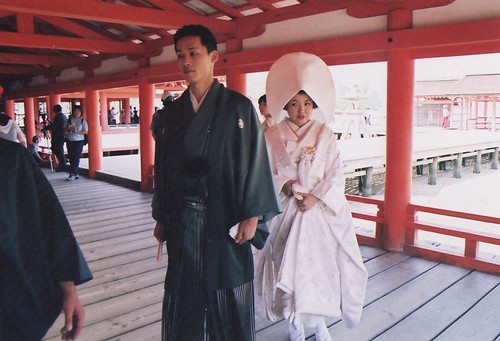
During a traditional wedding, Japanese brides must be painted white from head to toe as a symbol of purity. The Japanese wedding dress consists of a long white kimono called shiro-maku. Japanese brides also wear their hair in an elaborate traditional style decorated with combs and other accessories. During the Japanese ceremony a hood covers the Japanese brides head to signify that she will be a serene and patient wife.

Japanese brides also carry traditional accessories much like the "something old, something new, something borrowed and something blue" of the American wedding. They carry a small, sack-like purse, known as hakoseko, and a delicate sheathed dagger, called a kaiken.

The groom's ensemble is much simpler. He wears black pleated pants, and a short black kimono, emblazoned with his family seal.

The traditional Japanese ceremony consists of three parts. First, the couple is purified by the Shinto priest. Then, the bride and groom recite the traditional vows. Finally, Japanese brides and grooms perform a ceremony known as san-san-kudo, or three times three, during which they drink nine cups of sake, a wine. Their families also drink sake to symbolize the unity of both the couple and the two families. During the ceremony the two families do not face the couple being married, instead they face each other, as though the families are being married along with couple.

After the wedding, Japanese brides put on a more colorful kimono for the wedding reception. This second kimono is usually red, because red is a lucky color in Japan. It is always heavily embroidered with colorful scenes from nature. The sleeves are long and flowing. Never again will the bride wear such sleeves, or such a richly patterned gown, since only young, unmarried women are allowed to wear them. For this reason, the Japanese wedding dress is often rented rather than bought.

The wedding reception is a more open affair. Friends, co-workers, and more distant relatives are all allowed to attend. They often give monetary gifts in decorative envelopes to help the couple pay for their wedding. Games, songs, food, and speeches provide entertainment during the reception. Some time during the reception, Japanese brides may change again, this time, into a western-style gown.

Especially among the young couples, the Japanese ceremony is starting to take on more Western elements, such as the exchange of rings, and the traditional wedding is beginning to be replaced by a melding of cultures that mirrors the diversity of the young couples of Japan.


Source : http://www.syl.com/articles/japanesebridesandjapaneseweddingdress.html

The Japanese Weddings


Spring and fall are popular seasons for weddings in Japan. Traditional Japanese wedding ceremony are Shinto-style and are held at shrines (jinja). In a Shito-style wedding ceremony, the bride wears a traditional wedding kimono called shiromuku (white kimono), and the groom wears montsuki haori hakama. Usually, only family members and close relatives of the couple attend the Shinto-style wedding ceremony. The ceremony includes sake drinking rituals, exchanging wedding rings, and more. There are neither bridesmaids nor a best man, and an older married couple called nakoudo (matchmaker) attend the ceremony.

Most of weddings in Japan are held at hotels or wedding halls. Chapels and shrines are conveniently located within the facilities, and couples can choose the style of their wedding ceremonies. A Japanese wedding ceremony can be Christian, Buddhist, Shinto, and non-religious styles. The wedding style doesn't necessarily match with one's religion. Non-Christian couples often have their weddings ceremony at chapels.

After the wedding ceremony, the reception party called "kekkon hiroen" is held. The style and scale of wedding receptions vary depending on the regions. Typically, relatives, friends, co-workers, and neighbors attend the reception. When you receive an invitation card, you need to return the enclosed card and let them know if you can attend or not as soon as possible.

If you are attending a Japanese wedding reception, you are expected to bring cash for a gift. The amount depends on your relationship with the couple and the region, unless fixed amount is indicated in the invitation card. It is recommendable to ask someone who are attending the same wedding. The average is 30,000 yen for a friend's wedding. It's important that the cash is enclosed in a special envelope called shugi-bukuro, and your name is written on the front. It's polite to use new bills with no creasing. When you go to the party, give the envelope to the person at the reception desk and sign your name in the guestbook. People usually dress formally to attend a Japanese wedding reception. Female guests wear dresses, suits, or kimono. Male guests wear black formal suits.

The bride and broom change costumes a couple of times during the wedding reception. The bride wears a wedding kimono or a wedding kimono, and colorful dresses. The groom wears a men's montsuki hakama and a tuxedo. During the reception, the married couple sits on a stage enjoying the guests' speeches and performances. Some guests are asked to do something at the reception. Many people sing their favorite songs. The couple cut a large wedding cake and walks around the room, lighting the candles and greeting guests. A full course meal is often served at the table.
At the wedding reception, souvenirs called hikidemono are prepared in a bag for guests to take home. They are often tableware, sweets, interiors, and so on. In recent years, gift catalogs from which guests can choose gifts are popular as hikidemono.

The average cost of a typical wedding and wedding party in Japan is said to be a couple million yen, and the number of guest ranges from 50 to 200 for an average couple.


Source : http://gojapan.about.com/cs/traditionculture/a/japanesewedding.htm